
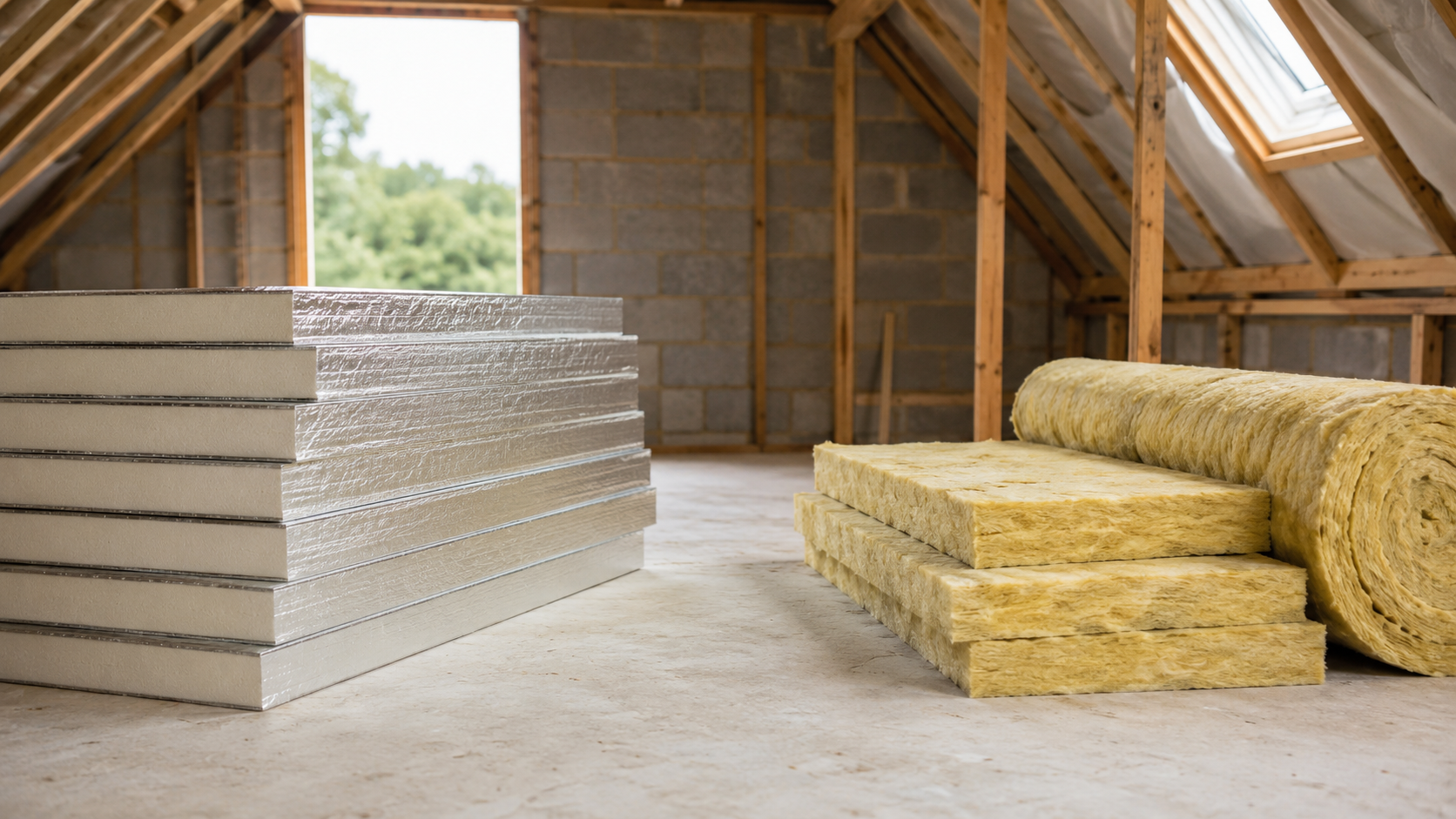
Choosing the right insulation can have a major impact on how warm, quiet, efficient and compliant a building feels. Two of the most widely used options in the UK are PIR insulation and mineral wool insulation.
Both materials are popular, both are used in domestic and commercial projects, and both can help improve building performance. However, they are not the same product and they should not always be used in the same way.
PIR insulation is commonly supplied as rigid foil-faced boards and is known for delivering strong thermal performance in a relatively thin profile. Mineral wool, on the other hand, is a fibrous insulation material available in rolls, slabs and batts, often chosen for sound absorption, fire performance and ease of fitting between studs, joists and rafters.
So, which is better: PIR or mineral wool?
The answer depends on the job. A flat roof, loft floor, internal partition, cavity wall, garage conversion and acoustic floor can all have different requirements. In this guide, we compare PIR and mineral wool insulation in detail to help UK homeowners, builders, contractors and specifiers choose the right product.
Quick Comparison: PIR vs Mineral Wool
| Feature | PIR Insulation | Mineral Wool Insulation |
|---|---|---|
| Format | Rigid insulation boards | Rolls, slabs or batts |
| Main strength | High thermal performance in less space | Fire, acoustic and flexible fitting benefits |
| Thermal efficiency | Excellent for its thickness | Good, but usually needs greater depth |
| Sound insulation | Limited acoustic absorption | Very good acoustic performance |
| Fire performance | Depends on product and system | Many products are non-combustible |
| Installation | Requires accurate measuring and cutting | Flexible and easier to fit around awkward areas |
| Common uses | Floors, roofs, walls, flat roofs, cavity walls | Lofts, partitions, timber frames, separating floors |
| Best for | Space-saving thermal upgrades | Sound control, fire performance and irregular spaces |
What Is PIR Insulation?
PIR stands for polyisocyanurate. It is a rigid foam insulation material usually manufactured as boards with foil facings on both sides. These foil-faced boards are widely used across UK construction because they provide high thermal resistance without needing excessive thickness.
PIR boards are commonly used in:
- Flat roofs
- Pitched roofs
- Solid floors
- Suspended timber floors
- Cavity walls
- Internal wall insulation
- External wall systems
- Garage conversions
- Extensions
- Garden rooms
- Commercial roofing and flooring projects
The main advantage of PIR is that it can help achieve strong insulation performance where space is restricted. This makes it especially useful in projects where every millimetre matters, such as loft conversions, room-in-roof upgrades, floors with limited build-up height, or internal wall lining systems.
PIR is usually chosen when thermal performance is the main priority.
What Is Mineral Wool Insulation?
Mineral wool is made from fibres produced using materials such as glass or stone. It is supplied in flexible rolls, semi-rigid slabs or batts, depending on the intended use.
There are two main types:
Glass mineral wool is often used for lofts, timber frames, partitions and general thermal insulation.
Rock mineral wool is often used where acoustic performance, density, durability and fire resistance are important.
Mineral wool is commonly used in:
- Loft spaces
- Internal stud walls
- Timber frame walls
- Separating walls
- Separating floors
- Suspended floors
- Acoustic partitions
- Ceiling systems
- Cavity walls
- Commercial buildings
- Fire-rated construction systems
The biggest strengths of mineral wool are its flexibility, sound absorption and fire performance. Because it is fibrous, it can fit neatly between studs and joists and help reduce sound transfer through floors and walls.
Mineral wool is usually chosen when acoustic comfort, fire performance or easy fitting are important.
The Main Difference Between PIR and Mineral Wool
The simplest way to compare the two is this:
PIR is usually the better choice when you need high thermal performance in a thinner board.
Mineral wool is usually the better choice when you need acoustic insulation, fire performance or a flexible material that can fit between framing.
Both products can insulate effectively, but they solve different problems. PIR is often used where space is tight and energy efficiency is the main goal. Mineral wool is often used where sound control, non-combustibility or flexible installation matters more.
For this reason, the best insulation choice depends less on which material is “better” overall and more on where it is being installed.
Thermal Performance
When it comes to thermal performance, PIR generally has the advantage.
PIR insulation boards usually offer better thermal performance per millimetre than mineral wool. This means you can often use a thinner PIR board to achieve a similar level of insulation compared with a thicker layer of mineral wool.
This is why PIR is frequently used in floors, walls and roof build-ups where there is limited space available.
For example, if you are insulating a pitched roof between rafters, you may not have enough depth for a thick layer of insulation. PIR can help achieve good thermal performance without taking up too much internal space.
Mineral wool still provides good thermal insulation, but it usually requires more thickness to reach the same performance level. In areas where space is not a major issue, such as open loft floors, this may not be a problem.
Best for thermal performance in limited space: PIR
Best where there is plenty of depth available: Mineral wool can be a practical option
Fire Performance
Fire performance is one of the biggest reasons mineral wool is specified.
Many mineral wool products are non-combustible, making them suitable for a wide range of fire-focused applications. This is particularly important in commercial buildings, multi-occupancy properties, separating walls, separating floors and areas where a fire strategy requires non-combustible materials.
PIR insulation can be used in many construction applications, but it must be correctly specified as part of a suitable system. PIR has a foam core, so its fire performance depends on the product, facing, surrounding materials and overall build-up.
This does not mean PIR is unsuitable. It simply means that it should be used where the specification allows it and installed according to the manufacturer’s guidance.
Best for fire-focused applications: Mineral wool
Suitable for many thermal applications when correctly specified: PIR
Acoustic Performance
If sound reduction is a key requirement, mineral wool is usually the stronger choice.
The fibrous structure of mineral wool helps absorb sound inside cavities. This makes it ideal for reducing noise between rooms, floors and properties.
Mineral wool is often used in:
- Internal stud partitions
- Bedroom walls
- Home offices
- Music rooms
- Cinema rooms
- Separating floors
- Apartment buildings
- Schools
- Offices
- Healthcare buildings
PIR is designed primarily as a thermal insulation board. It can form part of a wall or floor build-up, but it is not usually selected as the main acoustic insulation layer.
If the purpose of the project is to reduce airborne sound or improve acoustic comfort, mineral wool is normally the more appropriate product.
Best for acoustic insulation: Mineral wool
Ease of Installation
PIR and mineral wool are installed in very different ways.
PIR boards are rigid, so they need to be cut accurately. This is especially important when fitting boards between rafters, joists or studs. Any gaps around the edges can reduce performance and may need to be sealed with foam or tape.
PIR can be very efficient on straight, even surfaces. However, it can be more time-consuming in older properties or irregular spaces where framing is uneven.
Mineral wool is more flexible. It can be friction-fitted between timber or metal studs, wrapped around awkward areas and adjusted more easily during installation.
This makes mineral wool particularly useful in lofts, partitions and suspended floors. However, it should not be over-compressed, as this can reduce performance.
Easier for regular, board-based installations: PIR
Easier for awkward or uneven spaces: Mineral wool
Moisture and Breathability
Moisture control is important with any insulation material.
PIR boards usually have a closed-cell foam structure and foil facings. This can be useful in some applications, but it also means vapour control and condensation risk must be considered properly.
Mineral wool is generally more vapour-open, depending on the product, but it must be kept dry. If mineral wool becomes wet, its thermal performance may be affected.
Neither material should be installed without considering the full wall, floor or roof build-up. The correct use of vapour control layers, breather membranes and ventilation is essential, particularly in roofs, timber frames and retrofit projects.
Key point:
Moisture performance depends on the whole system, not just the insulation material.
Mineral wool is often cheaper than PIR on a basic material cost comparison. This makes it a popular choice for lofts, partitions and large areas where thicker insulation can be used without causing issues.
PIR boards are generally more expensive, but they can be more efficient where space is limited. If a thinner board helps avoid raising a floor, lowering a ceiling or increasing wall depth, the higher product cost may be worthwhile.
When comparing costs, consider:
- Product price
- Required thickness
- Labour time
- Cutting and waste
- Tapes, fixings and membranes
- Project type
- U-value requirements
- Fire and acoustic performance requirements
The cheapest product is not always the best value. The right product is the one that performs correctly in the specific application.
PIR vs Mineral Wool: Best Uses Summary
| Project Type | Best Choice | Why |
| Loft floor | Mineral wool | Cost-effective and easy to roll between joists |
| Flat roof | PIR | High thermal performance in warm roof systems |
| Pitched roof | PIR | Strong performance where rafter depth is limited |
| Internal partition | Mineral wool | Better acoustic performance |
| Separating floor | Mineral wool | Sound absorption and fire performance |
| Ground floor | PIR | Thermal performance and board format |
| Cavity wall | PIR or mineral wool | Depends on partial-fill or full-fill design |
| Timber frame | Mineral wool or combined system | Flexible between studs; PIR useful as continuous layer |
| Garden room | PIR | Space-saving thermal performance |
| Acoustic project | Mineral wool | Better sound absorption |
| Fire-focused project | Mineral wool | Many products are non-combustible |
| Space-limited project | PIR | Better insulation per thickness |
PIR vs Mineral Wool by Application
Loft Insulation
For standard loft floors, mineral wool is usually the most common option. It is cost-effective, easy to roll between joists and suitable for large open loft spaces.
PIR can be used in roof slopes or loft conversions, especially where space is limited and strong thermal performance is needed.
Best for standard loft floors: Mineral wool
Best for sloping roof insulation: PIR, depending on the roof design
Flat Roofs
PIR is widely used in flat roof insulation systems because it provides excellent thermal performance without making the roof build-up too thick.
Flat roof PIR boards are commonly used in warm roof systems and are available for different waterproofing finishes.
Mineral wool may also be used in flat roofs where fire or acoustic performance is a key requirement, but it must be specified as part of a suitable system.
Best for most thermal flat roof applications: PIR
Best for fire-focused flat roof systems: Mineral wool, where specified
Pitched Roofs
PIR boards are often chosen for pitched roofs because they can achieve good performance between and under rafters without using too much space.
Mineral wool can also be used in pitched roofs, but it may require more thickness. It can be useful where rafters are irregular or where acoustic performance is important.
Best for space-saving roof insulation: PIR
Best for flexible fitting and sound absorption: Mineral wool
Floors
For ground floors and solid floors, PIR boards are commonly used because they provide strong thermal insulation and a practical board format.
For separating floors or suspended timber floors where sound reduction is important, mineral wool is often preferred.
Best for thermal floor insulation: PIR
Best for acoustic floor insulation: Mineral wool
Internal Walls and Partitions
Mineral wool is usually the better option for internal partitions, especially where reducing sound between rooms is important.
PIR may be used for internal wall insulation where the goal is to improve thermal performance, particularly in solid wall properties or garage conversions.
Best for acoustic partitions: Mineral wool
Best for slim thermal wall upgrades: PIR
Cavity Walls
Both PIR and mineral wool can be used in cavity wall construction, but the correct choice depends on the wall design.
PIR boards are commonly used in partial-fill cavity wall systems where high thermal performance is needed within a specific cavity width.
Mineral wool cavity slabs are commonly used in full-fill cavity applications where the product is designed for that purpose.
Best for partial-fill cavity walls: PIR
Best for full-fill cavity walls: Mineral wool cavity slabs
Timber Frame Construction
Mineral wool is widely used between timber studs because it can friction-fit into the frame and accommodate small irregularities.
PIR can also be used in timber frame systems, particularly as a continuous layer to reduce thermal bridging.
Best between studs: Mineral wool
Best as a continuous insulation layer: PIR
When Should You Choose PIR?
PIR insulation is a strong option when you need:
- High thermal performance
- A thinner insulation build-up
- Rigid boards for floors, walls or roofs
- Flat roof insulation
- Cavity wall boards
- Garage conversion insulation
- Garden room insulation
- A space-saving insulation solution
PIR is particularly useful when the project needs to meet thermal targets but there is limited room for thicker materials.
When Should You Choose Mineral Wool?
Mineral wool is a strong option when you need:
- Acoustic insulation
- Fire performance
- Non-combustible insulation options
- Loft insulation
- Partition wall insulation
- Flexible fitting between studs or joists
- Separating wall or floor insulation
- A cost-effective insulation material for larger spaces
Mineral wool is often the better choice where sound control, fire requirements or irregular spaces are the main concern.
Can PIR and Mineral Wool Be Used Together?
Yes, PIR and mineral wool can be used together in some projects.
For example, a building might use PIR boards in the floor and roof for thermal performance, while using mineral wool in internal partitions for sound control. Another project might use mineral wool between timber studs and PIR as a continuous insulation layer.
However, combining insulation materials should be done carefully. The full build-up needs to account for condensation risk, fire performance, ventilation and installation detailing.
If the project is complex, it is worth checking manufacturer guidance or speaking with a professional before installation.
Common Mistakes to Avoid
Choosing Insulation Based Only on Thickness
A thicker product is not always better. The material’s thermal conductivity and intended use are just as important.
Using PIR for Acoustic Projects
PIR is not usually the right choice when sound reduction is the main priority. Mineral wool is generally better for acoustic insulation.
Compressing Mineral Wool
Mineral wool should fit snugly, but it should not be squashed tightly into place. Over-compression can reduce its performance.
Leaving Gaps Around PIR Boards
Rigid boards need careful cutting. Gaps between boards or around edges can reduce insulation effectiveness.
Ignoring Fire Requirements
Always check whether the project needs a specific fire classification or non-combustible insulation.
Forgetting Ventilation and Vapour Control
Insulation should be installed as part of a complete system. Ventilation, membranes and vapour control layers all matter.
Using the Wrong Product for the Area
Loft roll, cavity slab, acoustic slab, flat roof board and floor board are not always interchangeable. Always choose a product designed for the application.
Which Is Best for UK Homes?
For UK homes, PIR and mineral wool both have valuable uses.
PIR is often a strong choice for extensions, flat roofs, floors, garage conversions, garden rooms and internal wall insulation where high thermal performance is required in a slim profile.
Mineral wool is often a strong choice for lofts, internal stud walls, bedrooms, home offices, acoustic upgrades and separating floors.
In many properties, the best solution is not one material across the entire building. It may be PIR in one area and mineral wool in another.
Which Is Best for Trade and Commercial Projects?
For trade and commercial work, the decision is usually led by the specification.
PIR is commonly used where thermal efficiency, board format and reduced build-up depth are key requirements. This includes flat roofing, floors, cavity walls, extensions and high-performance residential projects.
Mineral wool is commonly used where fire performance, acoustic performance or non-combustibility are essential. This includes commercial buildings, schools, apartment blocks, offices and separating wall or floor systems.
Contractors should always check the product datasheet, certification and installation guidance before ordering.
Conclusion
PIR and mineral wool are both effective insulation materials, but they are not designed to do exactly the same job.
Choose PIR insulation if your project needs strong thermal performance in a slim, rigid board.
Choose mineral wool insulation if your project needs sound absorption, fire performance, flexibility or a material that can fit easily between studs and joists.
For many UK projects, the best result comes from using the right material in the right place. PIR may be ideal for the roof or floor, while mineral wool may be better for partitions, lofts or acoustic areas.
Before buying, consider the application, required performance, available space, fire requirements, acoustic needs and installation method.
FAQs
1. Is PIR better than mineral wool?
PIR is better for thermal performance in limited space. Mineral wool is better for acoustic insulation, flexible fitting and fire-focused applications.
2. Is mineral wool better than PIR?
Mineral wool is better where sound reduction, fire performance and flexibility are important. PIR is better where a thinner, high-performance insulation board is needed.
3. Which insulation is warmer: PIR or mineral wool?
PIR usually provides better thermal performance per millimetre, meaning it can often achieve similar insulation levels with less thickness.
4. Which is better for soundproofing?
Mineral wool is usually better for soundproofing because its fibrous structure absorbs sound within walls, floors and ceilings.
5. Is PIR insulation fire resistant?
PIR can be used in many compliant building systems, but it is not generally classed in the same way as non-combustible mineral wool. Always check the product datasheet and project specification.
6. Is mineral wool non-combustible?
Many mineral wool products are non-combustible, particularly products designed for fire-rated systems. Always confirm the classification on the manufacturer’s datasheet.
7. Which is cheaper, PIR or mineral wool?
Mineral wool is often cheaper per square metre, but PIR can be more cost-effective where less thickness is needed to achieve the required thermal performance.
8. Can I use mineral wool instead of PIR?
In some applications, yes. However, you may need a greater thickness of mineral wool to achieve similar thermal performance.
9. Can I use PIR instead of mineral wool?
Sometimes, but PIR is not usually the best replacement where acoustic absorption or non-combustibility is required.
10. Which insulation is best for lofts?
For standard loft floors, mineral wool is usually the most common and cost-effective option. For sloping roof insulation, PIR may be suitable depending on the construction.
11. Which insulation is best for flat roofs?
PIR is commonly used for flat roof insulation because it offers strong thermal performance in a thinner build-up.
12. Which insulation is best for internal walls?
Mineral wool is usually best for acoustic internal partitions. PIR or insulated plasterboard may be better for thermal internal wall insulation where space is limited.
13. Which insulation is best for floors?
PIR is commonly used for thermal floor insulation. Mineral wool is often better for acoustic floor build-ups and separating floors.
14. Can PIR and mineral wool be used in the same project?
Yes, many projects use both materials in different areas. PIR may be used for thermal insulation, while mineral wool may be used for acoustic or fire-focused areas.
15. What should I check before buying insulation?
Check the application, thickness, thermal conductivity, fire classification, acoustic performance, board or roll size, installation method and compatibility with the full construction build-up.
Need help choosing the right insulation for your next project? Explore our range of PIR insulation boards, mineral wool rolls, acoustic slabs and specialist insulation products online. Whether you are working on a loft, roof, wall, floor, extension or commercial build, choosing the right product from the start can help improve performance, reduce waste and make installation easier.